
Commercial
Commercial vs residential cleaning: what actually changes
The cleaning is similar. The contract around it is not. Workplaces are quoted on scope, cleaned outside working hours, and judged by people who never met the cleaner.
By Hygiene Maids of Plano6 min read
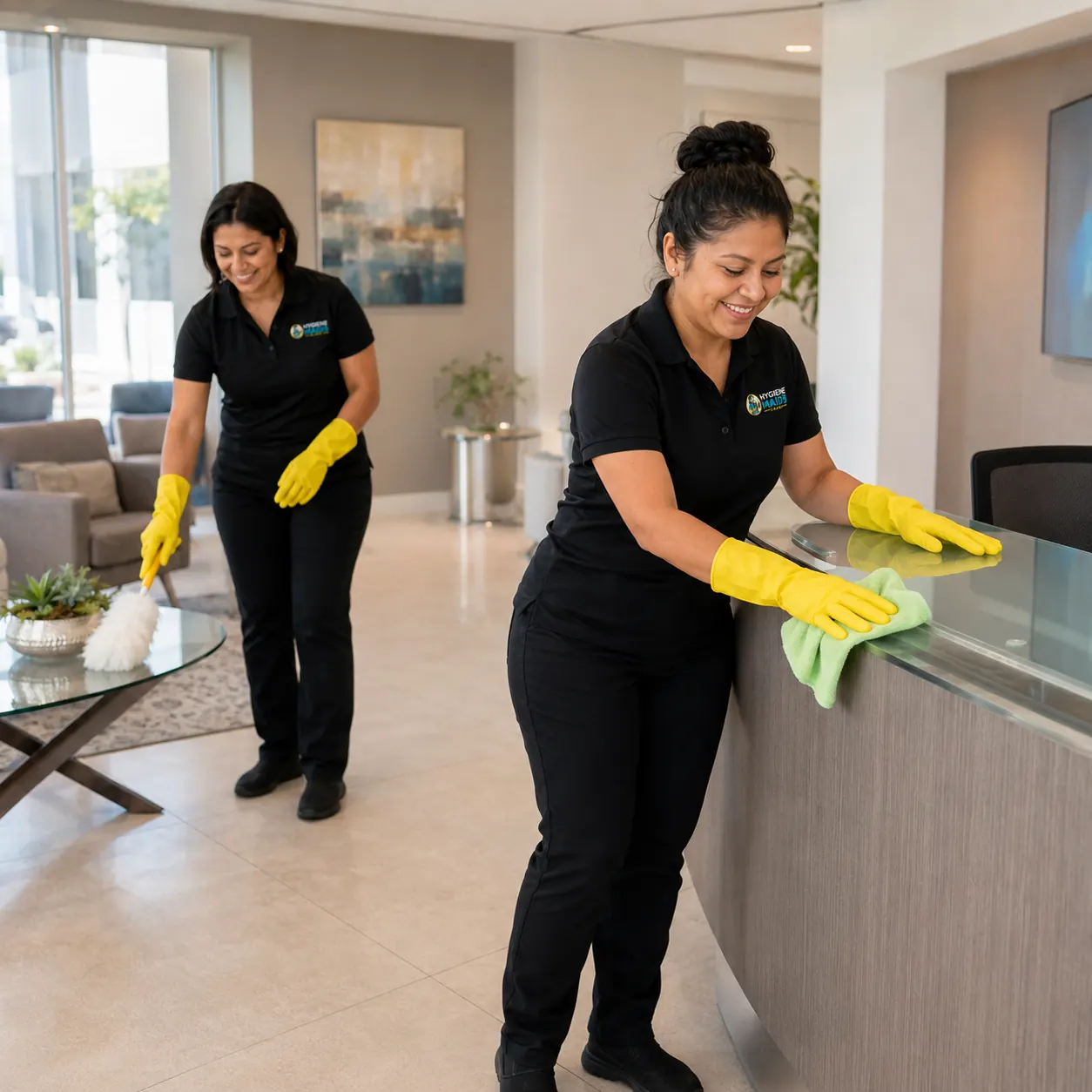
Business owners arranging cleaning for the first time usually have one reference point: the person who cleans their house. It’s a reasonable starting assumption and it holds for about the first ten minutes of the conversation.
What is genuinely the same
Quite a lot, and it’s worth saying so before the differences.
The physical work overlaps heavily. Restrooms are restrooms. Floors are floors. Dust behaves the same way in a conference room as in a living room, and the same rules apply to removing it: work top down, dry before wet, floors last, keep cloths separated by area.
The standards for who does the work should be identical too. Whether someone is alone in your house at 10am or alone in your office at 10pm, the questions are the same — is the company bonded and insured, and has the cleaner been vetted and background checked?
Five things that change
1. The scope is written down, and so are the exclusions
A house clean can run on a shared understanding. A workplace cannot, because the person who agreed the arrangement usually isn’t the person who notices it went wrong.
Commercial scopes are documents. They set out what’s cleaned, at what frequency, and — more importantly — what isn’t. Nearly every dispute in commercial cleaning traces back to something that was assumed rather than written.
2. Frequency comes from usage, not size
Homes are cleaned on a rhythm that suits the household. Workplaces are cleaned according to how hard they’re used, and the strongest signal is restroom load.
A twelve-person practice at full attendance can need more frequent visits than a forty-desk office running at a third occupancy. Floor area matters far less than most people expect.
3. The work happens when nobody’s there
Almost all commercial cleaning is out of hours — after close, before opening, or between services. That makes access a real subject rather than an afterthought: keys, codes, fobs, alarm procedures, building management sign-in, and which entrance a contractor uses after dark.
In managed buildings, and a large share of Plano office space is managed, there’s usually a contractor process to satisfy before the first visit as well. Insurance documentation, out-of-hours notification, loading access. None of it is difficult. All of it is better settled in advance than at nine on a Tuesday evening.
4. Somebody else judges the result
A homeowner sees their own clean and reacts to it directly. In a workplace, the person who signed the contract hears about it from staff, from visitors, or from a complaint about a restroom.
That distance is why commercial arrangements need a reporting route — a named contact, an expected response time, and a clear process when something is missed. Without one, small problems become contract problems.
5. Consistency is worth more than any single visit
Nobody in an office notices a good clean. They notice an inconsistent one. A workplace that’s excellent on Monday and mediocre on Thursday reads as unreliable, and that impression sticks harder than the average quality justifies.
It’s the main argument for having the same cleaners return to the same premises wherever the schedule allows. They learn which rooms are in use, what must not be touched, and which areas set the impression.
Side by side
| Residential | Commercial | |
|---|---|---|
| Scope | A standard scope, adjusted by conversation. | A written specification, including explicit exclusions. |
| Frequency | Weekly, biweekly or monthly to suit the household. | Set by usage and restroom load; often several times a week. |
| Timing | During the day, occupied or empty. | Out of hours, almost always in an empty building. |
| Access | A key, a code or someone at home. | Keys, alarms, building management sign-in and contractor procedures. |
| Priorities | Kitchen and bathrooms; whatever bothers the household most. | Restrooms, touch points, reception and anything client-facing. |
| Accountability | The person who booked it sees the result. | Staff and visitors see it; the signatory hears about it second-hand. |
| How it is bought | Bookable directly, priced on the property. | Quoted on scope after the space has been assessed. |
Why one is bookable and one is quoted
This is the question we get asked most by business owners, usually with a note of suspicion in it. It’s a fair question and the answer is straightforward.
A house has a predictable shape. Bedrooms, bathrooms, living areas, a kitchen. A booking form can ask four questions and get within range.
A workplace has no such shape. Two premises of identical floor area can differ by a wide margin depending on restroom count, floor types, how heavily the space is used, what hours are available, and whether there’s a building process to work within. A form that guessed from square footage would be wrong often enough to be useless.
So commercial work is quoted, and residential work is bookable. That’s the whole reason for the split.
Common mistakes
- Booking a house cleaner for an office. It can work for a very small suite. It stops working the moment you need out-of-hours access, restroom consumables tracked, or someone accountable for consistency.
- Scoping by floor area. Ask about restrooms first. It’s the number that actually predicts the work.
- Leaving desks undefined. Either run a clear-desk policy on cleaning nights, or state that only accessible surfaces are cleaned. Ambiguity here generates complaints in both directions.
- Comparing quotes without comparing scopes. A cheaper quote is frequently a smaller scope or fewer visits. Line them up item by item.
- Never reviewing the specification. Offices change. A scope written eighteen months ago is often cleaning a room nobody uses and missing one everybody does.
- Starting a schedule straight after a fit-out. Construction dust needs post-construction cleaning first. A regular visit will not absorb it, and it’ll keep resurfacing for two weeks.
Where commercial cleaning stops
Worth knowing before you ask, because plenty of companies will quote for these rather than admit they don’t do them. General commercial cleaning does not cover:
- Commercial kitchen exhaust and hood system cleaning.
- Medical, clinical or laboratory decontamination.
- Biohazard and trauma remediation.
- Industrial process cleaning and plant machinery.
- Exterior building, facade and high-rise window work.
These are regulated or specialist fields with their own training, equipment and certification. If your requirement sits in one of them, you want a specialist — and a cleaning company that says so is telling you something useful about how it operates.